
Implant Treatments
All-on-6 Implants
Comprehensive information about All-on-6 Implants, treatment steps and FAQs — Dentsmile.
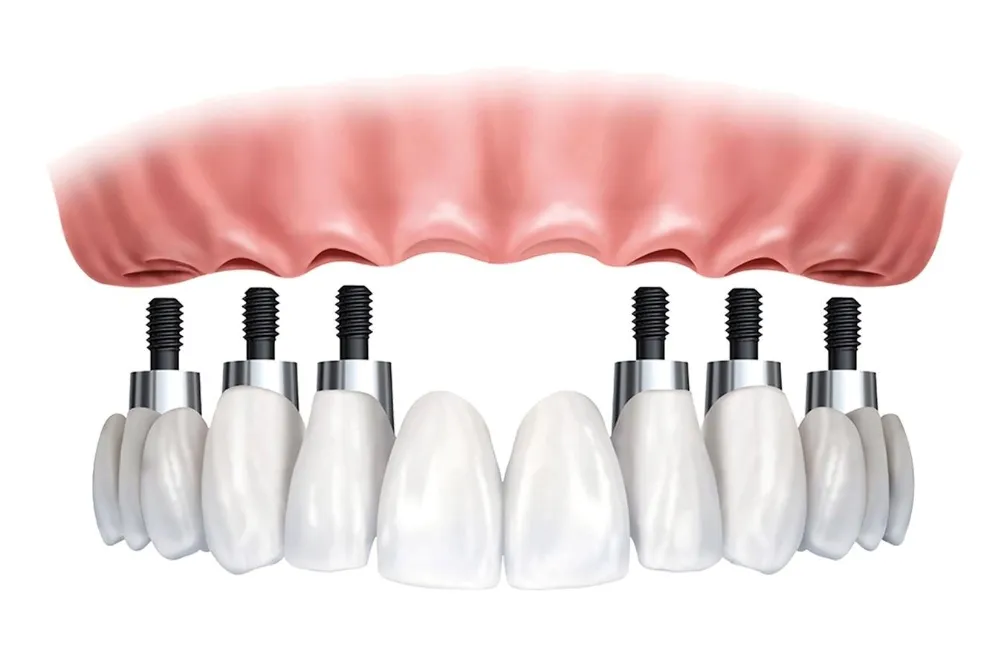
When all teeth have been lost, or when most of the remaining teeth can no longer be preserved in a healthy condition, one of the main expectations of our patients is to regain fixed teeth. Because removable dentures may cause problems such as movement, difficulty chewing, and reduced comfort, implant-supported fixed restorations have become an important treatment option for complete tooth loss.
All-on-6 implant treatment is based on placing six implants strategically within one jaw and supporting a fixed full-arch prosthesis with these implants. The objective is to distribute support evenly across the jaw, creating a fixed dental restoration designed to provide aesthetics, function, and long-term use.
At Dentsmile Clinic, when planning All-on-6 implant treatment in Üsküdar and Istanbul, we do not focus solely on placing implants into the bone. We plan implant positions according to the location of the final teeth, the patient's bite, facial structure, and chewing forces. In full-arch implant rehabilitation, one of the key factors for long-term success is planning the surgical and prosthetic stages together.
What Is All-on-6 Implant Treatment?
All-on-6 is a treatment in which six dental implants are placed in a completely edentulous jaw, or in a jaw where the remaining teeth cannot be successfully treated, to support a fixed full-arch prosthesis.
The treatment can be performed on:
The lower jaw
The upper jaw
Both jaws when necessary
Six implants provide support for the prosthesis from different areas and help distribute chewing forces across the jaw.
However, All-on-6 should not automatically be considered a standard treatment for every completely edentulous patient. The number and position of implants should be determined according to the patient's bone anatomy, anatomical conditions, and the design of the final prosthesis.
Who Is a Candidate for All-on-6?
All-on-6 treatment may particularly be considered for patients who:
Have lost all of their teeth
Are missing most of the teeth in one jaw
Have multiple teeth that cannot be preserved because of advanced periodontal disease
Have numerous severely decayed or fractured teeth
Have difficulty using removable complete dentures
Prefer fixed implant-supported teeth
The patient's general health and jawbone structure must be carefully evaluated before treatment.
Advanced age alone is not necessarily a contraindication to All-on-6 treatment. Systemic diseases, medications, oral hygiene, and bone condition may be more important determining factors than age itself.
How Is All-on-6 Treatment Planned?
In full-arch implant treatment, accurate planning is just as important as the surgical procedure itself.
Comprehensive Oral Examination
During the initial appointment, we evaluate:
Existing teeth
Gum health
Bite relationship
Oral hygiene
Facial and lip support
If there are natural teeth that can potentially be preserved, these are assessed individually.
3D Dental Tomography
3D Dental Tomography (CBCT) plays an important role in All-on-6 planning.
CBCT allows us to evaluate:
Jawbone height
Bone width
Bone structure
Nerve canals in the lower jaw
Sinus cavities in the upper jaw
Anatomical areas suitable for implant placement
in three dimensions.
This information helps determine the appropriate diameter, length, angle, and position of each implant.
Digital Intraoral Scanning
An intraoral scanner can be used to create a three-dimensional digital model of the teeth and soft tissues.
Evaluating digital impressions together with CBCT images helps us position the implants according to the requirements of the final prosthesis.
Prosthetically Driven Implant Planning
This is one of the principles we consider particularly important in All-on-6 treatment.
Rather than placing the implants first and then deciding how the final teeth should be designed, the ideal position of the teeth should be determined in advance.
Whenever possible, the implants are then positioned according to this prosthetic plan.
This approach can help achieve more appropriate:
Tooth positioning
Bite alignment
Lip support
Smile line
Distribution of chewing forces
How Is All-on-6 Implant Treatment Performed?
1. Extraction of Teeth That Cannot Be Preserved
If there are teeth that cannot be successfully treated, they are extracted according to the treatment plan.
In suitable cases, tooth extractions and implant placement can be performed during the same appointment.
2. Placement of Six Implants
Under local anesthesia, six implants are placed in predetermined areas of the jaw.
The implants are distributed to utilize suitable bone and provide balanced support for the forces that will be transmitted through the prosthesis.
When necessary, a digitally designed surgical guide may be used.
3. Preparation of Temporary Teeth
If the implants achieve sufficient primary stability during surgery, a temporary fixed prosthesis may be placed on the same day or shortly afterward in suitable patients.
This approach is known as immediate loading.
However, same-day fixed teeth are not appropriate for every patient. If bone quality or primary implant stability is insufficient, the implants are allowed to heal before loading.
4. Healing Period
The biological integration of dental implants with the jawbone is called osseointegration.
During this period, particularly for patients using a temporary fixed prosthesis, following dietary recommendations is important.
Softer foods are generally preferred during the initial healing period to avoid excessive forces on the implants.
5. Preparation of the Permanent Fixed Prosthesis
Once healing is complete, the permanent prosthetic phase begins.
Digital impressions and CAD/CAM technologies may be used to create a customized restoration.
At this stage, we carefully evaluate:
Tooth shape
Tooth color
Tooth size
Smile line
Lip support
Speech
Chewing function
Bite relationship
Advantages of All-on-6 Implant Treatment
The Possibility of Fixed Teeth
With All-on-6, the prosthesis is fixed to the implants and does not need to be removed and reinserted by the patient during daily use.
For patients who have used removable dentures for many years, this can provide a significant improvement in comfort.
Balanced Support from Six Implants
Proper distribution of six implants across the jaw allows chewing forces to be shared among several implants.
For this reason, All-on-6 can be an important treatment option for selected patients with sufficient bone.
Restoration of Chewing Function
Fixed implant-supported restorations can help patients chew with greater confidence and control.
A Natural, Personalized Smile
In full-arch treatment, tooth color alone does not determine the aesthetic result.
The teeth should be selected and designed according to the patient's:
Facial shape
Lips
Age
Smile line
Skin tone
Digital smile planning allows these factors to be evaluated together before treatment.
Eliminates the Movement Associated with Removable Dentures
Because the prosthesis is fixed to the implants, it does not move during speaking or chewing.
This can be particularly advantageous for patients who have difficulty using removable dentures in the lower jaw.
What Is the Difference Between All-on-4 and All-on-6?
Both treatments are designed to provide implant-supported fixed teeth for a completely edentulous jaw.
The main difference is the number of implants.
All-on-4 treatment uses four implants in one jaw, whereas All-on-6 treatment uses six implants.
In suitable cases, six implants may provide support from additional points and allow chewing forces to be distributed over a wider area.
All-on-4, on the other hand, may be an appropriate option for certain patients with limited posterior bone, as angled implants can sometimes help reduce the need for more extensive surgical procedures.
For this reason, there is no single answer to the question, "Is All-on-4 or All-on-6 better?"
For us, the appropriate method is the one that best suits the patient's anatomy and long-term treatment requirements.
Is Bone Grafting Required for All-on-6?
Bone grafting is not required in every patient.
However, prolonged tooth loss may lead to a reduction in jawbone volume.
Particularly in the posterior upper jaw, expansion of the maxillary sinus may reduce the amount of bone available for implant placement.
In such cases, additional procedures may include:
Bone grafting
Bone augmentation
Sinus lift surgery
A 3D CBCT examination helps determine whether these procedures are necessary.
Can Fixed Teeth Be Placed on the Same Day with All-on-6?
In suitable cases, yes.
When the implants achieve sufficient primary stability, a temporary fixed prosthesis may be prepared on the same day or within a short period.
However, there is an important distinction: the teeth fitted on the same day are generally temporary restorations.
Once the implants have completed osseointegration and the soft tissues have healed, the permanent prosthesis is prepared.
This process is important both for protecting the implants during healing and for producing a more accurately designed final restoration.
Is All-on-6 Treatment Painful?
Because surgery is performed under local anesthesia, patients are not expected to experience pain during the procedure.
As All-on-6 involves multiple implants and is a relatively comprehensive surgical procedure, patients may experience:
Swelling
Mild to moderate discomfort
Tenderness
Bruising in some cases
These symptoms are generally more noticeable during the first few days and gradually decrease when prescribed medications and postoperative care instructions are followed.
What Should You Eat After All-on-6 Treatment?
Diet is particularly important during the initial healing period in patients who undergo immediate loading.
The fact that a temporary prosthesis is fixed does not mean that the implants have already fully integrated with the jawbone.
For this reason, patients should initially avoid:
Hard-shelled foods
Nuts
Very tough meats
Foods that need to be cracked or broken with the teeth
Soft, easy-to-chew foods should be preferred.
The transition to a normal diet after placement of the permanent prosthesis should be made according to the dentist's clinical assessment.
How Long Do All-on-6 Implants Last?
It is not appropriate to define the lifespan of implant treatment with a specific number of years.
Long-term success depends on:
Correct implant positioning
Bone and gum health
Prosthetic design
Balanced bite forces
Oral hygiene
Smoking
Teeth clenching or grinding
Regular dental check-ups
Properly planned and well-maintained implants can function successfully for many years.
The prosthesis attached to the implants is a separate component and may require maintenance, repair, or replacement over the years because of wear, functional changes, or aesthetic considerations.
How Should All-on-6 Implants Be Cleaned?
Regular cleaning of fixed full-arch implant restorations is essential for long-term success.
The areas between the underside of the prosthesis and the gum tissue must be cleaned particularly carefully.
Depending on the design of the restoration, patients may use:
A toothbrush
Interdental brushes
Special dental floss designed for implant restorations
An oral irrigator
Dental implants do not develop cavities like natural teeth. However, inflammation can develop in the tissues surrounding them. If left untreated, this may progress to peri-implantitis, a condition that can affect the bone around the implants.
Regular professional examinations should therefore not be neglected.
All-on-6 Implant Prices
The cost of All-on-6 implant treatment varies from patient to patient.
The main factors affecting the price include:
Treatment of one or both jaws
Implant system used
Type of temporary prosthesis
Material used for the permanent prosthesis
Need for bone grafting
Need for sinus lift surgery
Additional surgical procedures
For this reason, evaluating the cost of All-on-6 treatment solely on the basis of the "price of six implants" can be misleading. The treatment should be considered as a whole, including the implants, surgical planning, temporary teeth, and permanent prosthesis.
All-on-6 Implant Treatment at Dentsmile Clinic
At Dentsmile Clinic – Üsküdar, Istanbul, we digitally plan All-on-6 treatments from the initial assessment of the patient's existing bone structure through to the final design of the permanent prosthesis.
When clinically indicated, we utilize:
3D Dental Tomography (CBCT)
Digital intraoral scanning
CAD/CAM technology
CEREC systems
Digital surgical guides
Digital smile design
One of the most important lessons we have learned from years of clinical experience with full-arch implant rehabilitation is that a successful outcome cannot be explained by the number of implants alone.
Simply using six implants does not guarantee successful All-on-6 treatment. The implants must be positioned correctly, the prosthesis must distribute chewing forces appropriately, the restoration must be compatible with the gum tissue and designed so that it can be effectively cleaned, and the patient must maintain regular oral hygiene and professional follow-up.
Frequently Asked Questions
What is All-on-6?
All-on-6 is a treatment in which six dental implants are placed in one jaw to support a fixed full-arch prosthesis.
Does All-on-6 require a separate implant for every tooth?
No. The six implants work together to support the full-arch fixed prosthesis. A separate implant beneath every missing tooth is not required.
Can teeth be fitted on the same day with All-on-6?
In patients with suitable bone structure and sufficient implant stability, temporary fixed teeth may be placed on the same day or shortly after implant surgery.
Is All-on-6 more durable than All-on-4?
It would not be accurate to make this judgment based solely on the number of implants. Both systems can be successful when used for the appropriate patient and planned correctly. The most suitable approach depends on the patient's bone anatomy and prosthetic treatment plan.
Is bone grafting always necessary for All-on-6?
No. Bone grafting may not be required when sufficient bone is available. If bone volume is inadequate, additional procedures such as bone grafting or sinus lift surgery may be considered.
Can All-on-6 implants be removed?
The implants themselves are fixed structures placed within the jawbone and are not removed by the patient. Depending on the design, the prosthesis attached to the implants may be removable by the dentist for professional maintenance or repair.
Why Is Proper Planning So Important in All-on-6 Treatment?
In complete tooth loss, patients often describe their main expectation simply as "having fixed teeth again." From a clinical perspective, however, successful treatment involves much more.
Patients should be able to chew comfortably, speak naturally, feel confident with their smile, and, importantly, clean their prosthesis effectively every day.
At Dentsmile Clinic – Üsküdar, Istanbul, we therefore approach All-on-6 implant treatment not simply as a surgical procedure involving the placement of six implants, but as a comprehensive full-arch rehabilitation in which surgery, function, and aesthetics are planned together.