
Cosmetic Dentistry
Crown Lengthening
Comprehensive information about Crown Lengthening, treatment steps and FAQs — Dentsmile. What Is Tooth Lengthening? Crown Lengthening for a More Balanced and Aesthetic Smile
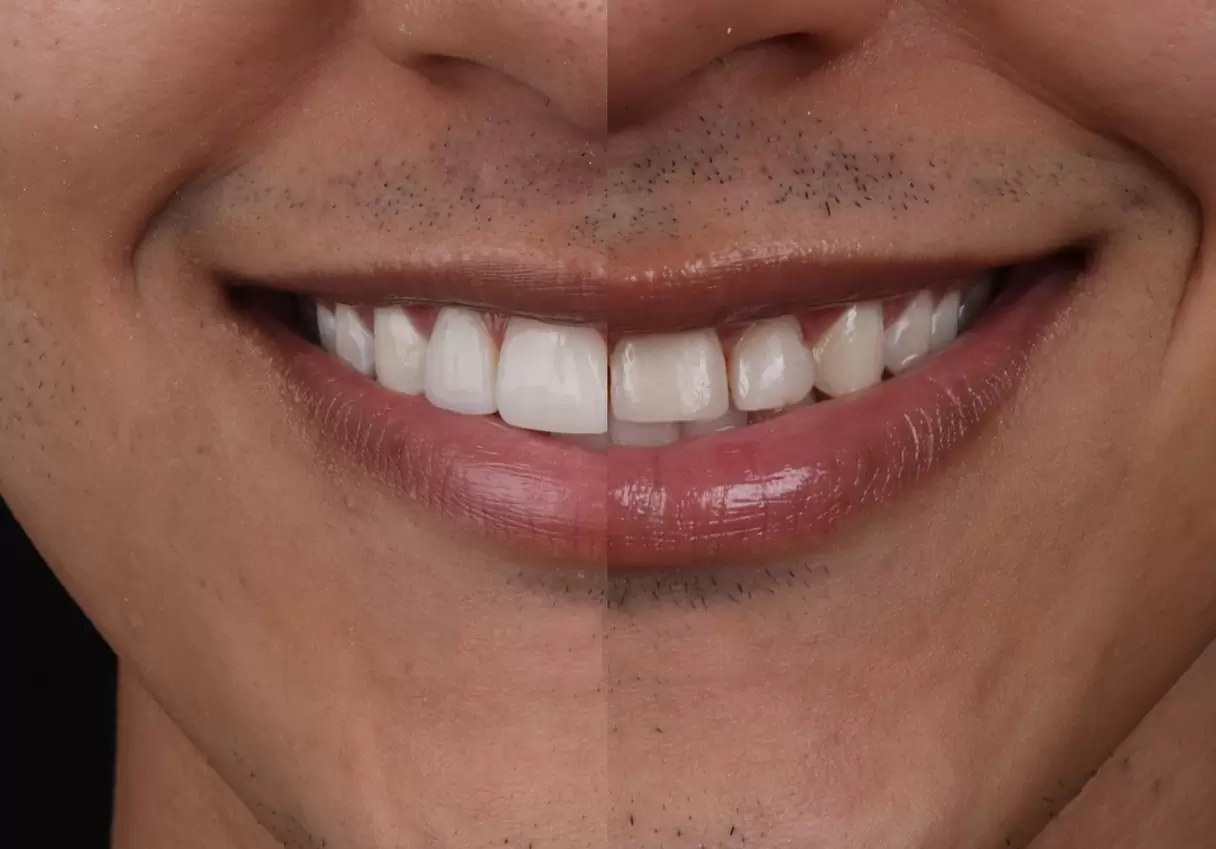
What Is Tooth Lengthening? Crown Lengthening for a More Balanced and Aesthetic Smile
Some patients visit us for aesthetic treatment because they feel that their teeth look too small or too short. However, an important detail we often identify during examination is that not every tooth that appears short is actually anatomically short. In some cases, the natural tooth dimensions are normal, but excessive gum tissue covers too much of the tooth surface, making the teeth appear short and square.
Tooth lengthening is a general term for treatments designed to increase the visible portion of the teeth for aesthetic or functional purposes. In dentistry, this procedure is most commonly referred to as clinical crown lengthening.
The treatment does not simply involve cutting the gums. In some patients, reshaping the gum tissue alone is sufficient, while in other cases the level of the bone surrounding the tooth must also be carefully adjusted.
At Dentsmile Clinic – Üsküdar, Istanbul, the first step in planning tooth lengthening treatment is determining why the teeth appear short. The appropriate treatment depends on the underlying cause.
What Is Tooth Lengthening?
Tooth lengthening is a procedure that increases the portion of the clinical crown visible above the gum line.
It may be performed:
For aesthetic purposes
Before restorative treatment
To expose healthy tooth structure in cases involving fractures or decay
In aesthetic cases, the aim is generally to make the teeth appear longer, better proportioned, and more harmonious with the smile.
In restorative cases, the objective is different. When decay or a fracture extends below the gum line, sufficient healthy tooth structure may need to be exposed before a filling or crown can be placed.
For this reason, tooth lengthening is not purely an aesthetic procedure. In some cases, it is functionally necessary to restore a tooth properly.
Why Do Teeth Look Short?
There are several reasons why teeth may appear short.
Excess Gum Tissue
In some patients, part of the natural crown of the tooth remains covered by gum tissue.
Although the teeth themselves are normal in size, the visible portion appears short, creating a small or square appearance.
Altered Passive Eruption
After the teeth erupt, the gum margin normally moves gradually toward its ideal position.
In some individuals, the gum tissue continues to cover a larger portion of the tooth than expected. This condition is known as altered passive eruption.
In these patients, the teeth may be anatomically normal in length but still appear short.
Tooth Wear
Habits such as teeth clenching and grinding can gradually wear down the incisal edges of the front teeth.
In these cases, the teeth have genuinely lost length.
Changing the gum level alone may not be sufficient. Lost tooth structure may need to be restored with composite bonding, porcelain veneers, or other restorative techniques.
Naturally Small Teeth
Some people naturally have smaller teeth because of genetic factors.
In these cases, simply removing gum tissue to make the teeth appear longer is not always appropriate. The width-to-length ratios of the teeth should be evaluated, and restorative treatment may be required.
What Is Aesthetic Tooth Lengthening?
Aesthetic tooth lengthening is most commonly performed on the front teeth.
The gum levels are adjusted to increase the portion of the teeth visible in the mouth.
This approach may be considered for:
Front teeth that appear short
Teeth with a square appearance
Asymmetrical gum levels
Suitable cases of gummy smile
Before porcelain veneer or zirconia treatment
The objective is not simply to make the teeth look as long as possible.
For a natural smile, the width-to-length proportions of the teeth must be maintained.
Teeth that are made excessively long can look just as unnatural as teeth that appear too short.
What Is Crown Lengthening?
Crown lengthening is a procedure in which the gums and, when necessary, the surrounding bone are reshaped to increase the visible or restorable portion of the tooth.
It can be performed for two main reasons:
Aesthetic crown lengthening: Used to improve tooth proportions and gum levels within the smile.
Functional crown lengthening: Used to access decay, fractures, or restorative margins located below the gum line.
The clinical technique may differ depending on the purpose of treatment.
Are Tooth Lengthening and Gingivectomy the Same Thing?
Not exactly.
A gingivectomy is the removal of excess gum tissue.
In some patients, if the relationship between the gum and bone is appropriate, gingivectomy alone may be sufficient to expose more of the tooth.
However, in other cases the bone lies very close beneath the gum tissue.
In such situations, removing only the gums may not be biologically appropriate. During healing, the gums may move back toward their previous level, or periodontal problems may develop over time.
These patients may require crown lengthening in which both the gum tissue and bone level are carefully adjusted.
For this reason, it is not appropriate to state before examination that “simply cutting the gums with a laser will be enough.”
When Is Tooth Lengthening Performed?
Treatment may be considered in cases involving:
Teeth that appear short and square
Excessive gum coverage of the tooth surface
Asymmetrical gum levels around the front teeth
Suitable cases of gummy smile
Decay extending below the gum line
Tooth fractures extending below the gum line
Insufficient healthy tooth structure for a crown or bridge
Need to adjust gum levels before porcelain veneers or zirconia restorations
Who May Not Be Suitable for Tooth Lengthening?
Crown lengthening is not the correct treatment for every tooth that appears short.
For example, if the main cause is advanced tooth wear, rebuilding the lost tooth structure may be more appropriate than removing gum tissue.
Treatment may also require a different approach in some patients with:
Active periodontal disease
Inadequate oral hygiene
An unfavorable crown-to-root ratio after treatment
Insufficient bone support
For this reason, periodontal and restorative evaluation should be performed together before treatment.
How Is Tooth Lengthening Planned?
Tooth and Gum Examination
The first step is determining whether the teeth are truly short or simply covered by excessive gum tissue.
Periodontal health and gum pockets are also assessed.
Analysis of Tooth Proportions
The width-to-length proportions of the front teeth are particularly important.
Even increasing the visible tooth length by only a few millimeters can significantly alter the overall character of the smile.
Each tooth should therefore be planned individually.
Smile and Lip Analysis
It is not enough to assess the teeth only when the mouth is open.
We evaluate how much of the teeth are visible:
At rest
While speaking
During a slight smile
During a full smile
Evaluation of Bone Level
This is one of the most important aspects of gum aesthetic planning.
The position of the bone below the gum margin is evaluated with periodontal measurements and, when necessary, radiographic imaging.
This determines whether soft-tissue reshaping alone is sufficient.
Digital Smile Design
Particularly in cases planned together with porcelain veneers, bonding, or zirconia restorations, Digital Smile Design may be used.
This allows the target position of both the teeth and gum margins to be planned before treatment begins.
How Is Tooth Lengthening Performed?
The procedure is performed under local anesthesia.
When Only the Gum Tissue Needs to Be Adjusted
If the bone level is appropriate, excess gum tissue is carefully removed and the gingival contours are reshaped.
This can be performed using gingivectomy and gingivoplasty techniques.
When Bone Level Also Needs to Be Adjusted
The gum tissue is carefully lifted, and the bone surrounding the tooth is reshaped according to the planned new gum margin.
The gum is then repositioned, and sutures may be placed when necessary.
This is a more extensive procedure than simple gum reshaping and has a different healing process.
Can Tooth Lengthening Be Performed with a Laser?
Dental lasers may be used to reshape gum tissue in suitable cases.
Laser treatment may help with:
Controlled soft-tissue reshaping
Reducing bleeding
Improving visibility of the surgical area
However, tooth lengthening should not be evaluated solely according to the device being used.
If the bone level also needs to be changed, removing only the gum tissue with a soft-tissue laser may not be sufficient.
The important factor is not whether a laser is used, but whether the periodontal treatment is planned correctly.
Is Tooth Lengthening Painful?
Because the procedure is performed under local anesthesia, pain is not expected during surgery.
Depending on the extent of treatment, patients may experience:
Sensitivity
Mild pain
Soreness
Limited swelling
afterward.
Procedures involving only soft-tissue adjustment generally have a more comfortable recovery period.
Crown-lengthening procedures involving bone reshaping may require a longer healing period.
Healing After Tooth Lengthening
During the first few days, it is important to protect the surgical area from trauma.
We generally advise patients to:
Avoid hard foods that may place pressure on the treated area
Maintain oral hygiene as recommended by the dentist
Avoid smoking
Use prescribed medications as instructed
Attend scheduled follow-up appointments
Superficial healing of the gums may occur relatively quickly. However, it may take longer for the tissues to mature and settle into their final position.
Particularly when permanent porcelain restorations are planned in the aesthetic region, sufficient time should be allowed for the gum level to stabilize.
Can the Gums Return to Their Previous Position After Tooth Lengthening?
Long-term stability is the goal of a properly planned crown-lengthening procedure.
However, if only the visible gum tissue is removed without considering the underlying bone level, the gums may move back toward their previous position during healing in some cases.
The amount of tissue removed should therefore not be determined solely according to aesthetic expectations.
The biological limits of the periodontal tissues must be respected.
Can Tooth Lengthening Treat a Gummy Smile?
In some patients, yes.
If the main cause of a gummy smile is excessive gum tissue covering the teeth, crown lengthening can be highly effective.
However, if the gummy smile is related to:
Excessive upper-lip movement
Vertical development of the upper jaw
Tooth position
gum treatment alone may not be sufficient.
The cause of the gummy smile should first be identified before selecting the appropriate treatment.
Can Composite Bonding Be Performed After Tooth Lengthening?
Yes.
Particularly in worn or naturally short teeth, adjusting the gum level alone may not be enough.
After gum reshaping, composite bonding can be used to lengthen the incisal edges and create more balanced tooth proportions.
In some cases, the most natural result is achieved by combining periodontal and restorative treatments.
Can Tooth Lengthening and Porcelain Veneers Be Combined?
Yes. This is a combination we frequently use in comprehensive smile design.
The gum levels are first adjusted to their ideal position.
After the tissues have healed, porcelain veneers can be prepared to improve:
Tooth length
Tooth width
Color
Shape
Smile line
The sequence of treatment is important. Whenever possible, periodontal planning should be completed before permanent porcelain restorations are fabricated rather than changing the gum levels afterward.
Will Teeth Be Sensitive After Tooth Lengthening?
Some patients may experience temporary sensitivity to hot and cold after the procedure.
Sensitivity can be more noticeable when part of the tooth root becomes exposed.
In most patients, this decreases over time. Desensitizing products or professional treatments may be used when necessary.
What Are the Advantages of Tooth Lengthening?
When performed for the correct indications, tooth lengthening can:
Improve the proportions of teeth that appear short
Create more symmetrical gum levels
Reduce excessive gum display during smiling
Make the teeth appear longer and better balanced
Create a more suitable gum line for porcelain veneers and other aesthetic restorations
Allow certain fractures and areas of decay below the gum line to be restored
The most important principle is to avoid removing more tissue than necessary.
In aesthetic dentistry, more intervention does not always mean a better result.
Is Tooth Lengthening Permanent?
Crown-lengthening procedures performed according to correct periodontal principles can provide stable long-term results.
However, gum levels are not completely unchanging throughout life.
Gum disease, oral hygiene, traumatic brushing, and periodontal changes over time can all influence gum position.
Regular follow-up examinations are therefore important.
Tooth Lengthening Prices
The cost of tooth lengthening varies according to the technique used and the number of teeth being treated.
Factors affecting treatment cost may include:
Number of teeth treated
Whether only gum tissue is reshaped
Whether bone level also needs to be adjusted
Extent of gummy smile treatment
Combination with bonding or porcelain veneers
Need for additional periodontal treatment
For this reason, it is not appropriate to determine a standard cost based solely on a “tooth lengthening price.”
During examination, the first step should be identifying why the teeth appear short and then planning the required procedure accordingly.
Tooth Lengthening at Dentsmile Clinic
At Dentsmile Clinic – Üsküdar, Istanbul, we evaluate the relationship between the tooth, gum, and bone when planning tooth lengthening treatment.
In aesthetic cases, when necessary, we may use:
Digital intraoral scanning
Digital Smile Design
Photographic analysis
Periodontal measurements
Radiographic imaging
Mock-up procedures
to support treatment planning.
A situation we frequently encounter in clinical practice is a patient who assumes that teeth appearing short need to be covered with crowns. However, in some patients, a significant portion of the natural tooth is simply hidden beneath the gum tissue.
In these cases, evaluating the gum and bone levels before unnecessarily reducing a healthy tooth and placing a restoration may offer a far more conservative approach.
Frequently Asked Questions
What is tooth lengthening?
Tooth lengthening is a procedure that increases the visible clinical crown of a tooth by reshaping the gum tissue and, when necessary, the surrounding bone.
Are tooth lengthening and crown lengthening the same thing?
The periodontal procedure in which the gum and bone levels are altered to increase the visible portion of the tooth is clinically known as crown lengthening.
Does tooth lengthening actually make the tooth longer?
In cases related to gum coverage, the tooth itself is not physically lengthened. A larger portion of the natural tooth surface that was previously covered by gum tissue becomes visible. In worn teeth, bonding or porcelain restorations can be used to add actual length to the tooth.
Can tooth lengthening be performed with a laser?
A laser may be used in suitable cases where soft-tissue reshaping alone is sufficient. Different surgical techniques are required when the bone level also needs to be changed.
Can the gums grow back after tooth lengthening?
Proper planning can provide long-term stability. However, if only excess gum tissue is removed without considering the underlying bone level, some tissue rebound or repositioning may occur.
Can porcelain veneers be placed after tooth lengthening?
Yes. Tooth lengthening may be performed before porcelain veneers and comprehensive smile design. The gums should be allowed to heal adequately before permanent porcelain restorations are completed.
How many teeth can be treated with tooth lengthening?
The procedure can be performed on a single tooth or multiple teeth within the smile line. The number of teeth treated depends on the existing gum levels and the aesthetic treatment plan.
Does tooth lengthening damage the teeth?
When performed for the correct indication and according to sound periodontal principles, it is a safe treatment. However, excessive removal of gum or bone tissue is not appropriate. The relationship between the tooth, root, and supporting bone should therefore be assessed before treatment.
Not Every Tooth That Looks Short Needs a Crown
In aesthetic dentistry, correct diagnosis is more important than the restorative material being used. When teeth appear short, the first step is understanding why.
If the problem is caused by the gum level, significant aesthetic improvement may be achieved through periodontal treatment without unnecessarily removing healthy tooth structure. If there is genuine tooth wear or loss of form, composite bonding or porcelain restorations can then be added when appropriate.
At Dentsmile Clinic – Üsküdar, Istanbul, our objective with tooth lengthening treatment is not to make the teeth look as long as possible. Our aim is to establish a natural relationship between the teeth, gums, lips, and facial proportions in order to create a healthy, balanced, and natural-looking smile.