
Implant Treatments
Multiple Tooth Implants
What Is a Multiple Tooth Implant? Implant Treatment for Multiple Missing Teeth
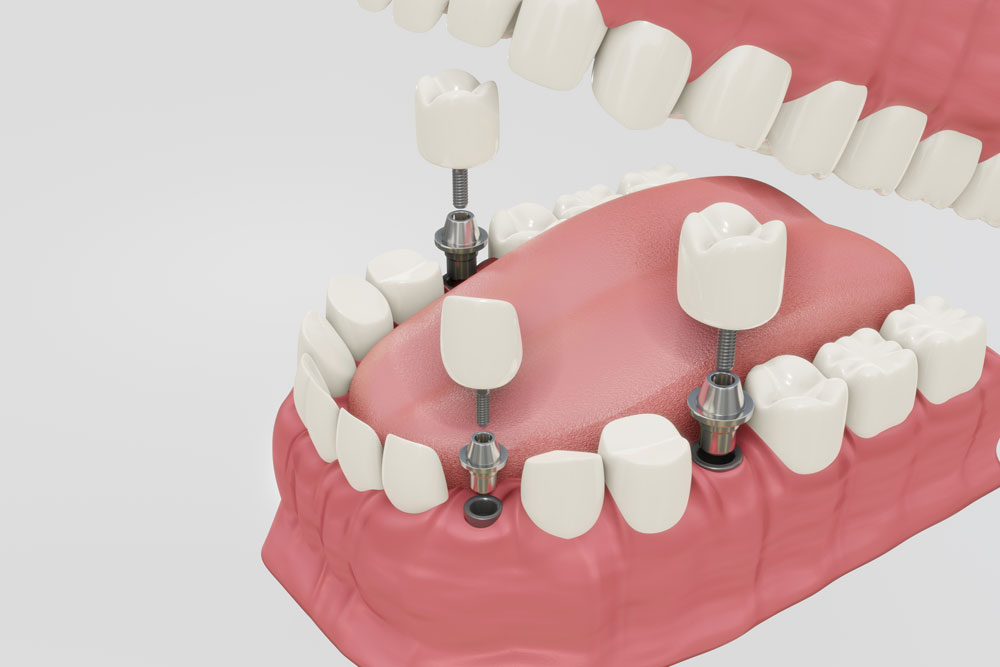
Losing several teeth can affect much more than the appearance of your smile. It may also influence chewing function, speech, bite alignment, and the health of the remaining teeth. In clinical practice, when missing teeth are left untreated for a long period, we frequently observe neighboring teeth shifting into the gaps, opposing teeth over-erupting, and gradual bone loss developing in areas that are no longer functioning.
Multiple tooth implant treatment involves replacing several missing teeth using dental implants for support. One of its most important advantages is that a separate implant is not necessarily required for every missing tooth. In suitable cases, several missing teeth can be replaced with a fixed bridge supported by a carefully planned number of implants.
At Dentsmile Clinic – Üsküdar, Istanbul, when planning multiple tooth implant treatment, we evaluate not only the number of missing teeth but also the structure of the jawbone, gum health, remaining natural teeth, bite relationship, and the chewing forces that the implants will need to support.
What Is Multiple Tooth Implant Treatment?
Multiple tooth implant treatment is used to replace several missing teeth, whether they are located next to each other in the same area or in different parts of the mouth.
Treatment can generally be planned in two ways:
Individual implants and implant-supported crowns can be placed for the missing teeth.
A fixed implant-supported bridge can be placed on a selected number of implants to replace several missing teeth.
For example, when three adjacent teeth are missing, it may not always be necessary to place three separate implants. If the bone structure, length of the missing area, and chewing forces are suitable, a three-unit fixed bridge may sometimes be supported by two implants.
However, we do not believe that the number of implants should be determined solely with the aim of reducing treatment costs. For long-term success, implant number and positioning must allow chewing forces to be distributed appropriately and predictably.
Why Should Multiple Missing Teeth Be Replaced?
After tooth loss, the natural balance within the mouth begins to change.
When multiple missing teeth remain untreated over time:
Chewing capacity may decrease.
Remaining teeth may be subjected to excessive forces.
Neighboring teeth may tilt or shift into the empty spaces.
Opposing teeth may over-erupt.
Bite alignment may deteriorate.
Bone loss may develop in areas where teeth are missing.
Facial and lip support may be negatively affected.
Effective chewing, the first stage of digestion, may become more difficult.
Missing posterior teeth are particularly likely to be ignored because they are not easily visible. However, molars carry a significant proportion of chewing forces. Their loss can gradually place excessive stress on the remaining teeth.
Who Is a Candidate for Multiple Tooth Implants?
Many adults who have lost several teeth and whose general health permits implant surgery may be candidates for multiple implant treatment.
Before treatment, the following factors should be carefully evaluated:
Height and width of the jawbone
Bone quality
Gum health
Number and location of missing teeth
Condition of the remaining natural teeth
Bite relationship between the upper and lower jaws
Oral hygiene
Smoking habits
Systemic diseases and medications
Teeth clenching or grinding habits
Based on this assessment, the appropriate number of implants and their ideal positions can be determined.
Is One Implant Required for Every Missing Tooth?
No. This is one of the questions we are most frequently asked about multiple missing teeth.
It is not always necessary to place an individual implant for every missing tooth. In certain cases, a fixed implant-supported bridge can be placed on two or more implants.
However, the appropriate number of implants varies from patient to patient.
When making this decision, we consider:
Number of missing teeth
Length of the edentulous space
Available bone at the potential implant sites
Whether the missing teeth are in the anterior or posterior region
The patient's chewing forces
Design of the final prosthesis
The primary objective is not to use the fewest possible implants, but to create an appropriate biomechanical treatment plan that can function successfully for many years.
How Is Multiple Tooth Implant Treatment Performed?
Examination and Radiographic Assessment
A detailed intraoral examination is performed before treatment.
When necessary, panoramic X-rays and 3D dental tomography (CBCT) are used to evaluate the jawbone in three dimensions.
This allows us to assess:
Available bone volume
Bone width
Nerve canals
Maxillary sinuses
Roots of neighboring teeth
Potential implant placement sites
Digital Implant Planning
Digital intraoral scans can be evaluated together with CBCT images to plan implant positions before surgery.
Placing implants at the correct angle and position is important not only for surgical success but also for the aesthetics and function of the final prosthetic restoration.
In suitable cases, a customized surgical guide can be prepared.
Implant Placement
Implant surgery is generally performed under local anesthesia.
The implants are placed in the predetermined positions. When required, additional procedures such as bone grafting may be performed during the same surgical session.
The duration of the procedure varies depending on the number of implants and the complexity of the surgery.
Healing Period
The biological integration of dental implants with the jawbone is known as osseointegration.
The duration of this process may vary depending on the patient's bone structure, the implant location, and any additional surgical procedures performed.
Temporary teeth may be used during the healing period in suitable cases.
Preparation of Fixed Implant-Supported Teeth
Once osseointegration is complete, the prosthetic phase begins.
Digital impressions are taken to prepare implant-supported crowns or bridges.
At this stage, we carefully evaluate:
Tooth color
Tooth size and shape
Relationship with the gum tissue
Contact with neighboring teeth
Bite relationship between the upper and lower jaws
Distribution of chewing forces
We do not assess the success of implant treatment solely by whether the implants integrate with the bone. Correct design of the prosthetic restoration is equally important for long-term success.
Advantages of Multiple Tooth Implants
Healthy Neighboring Teeth Can Be Preserved
With conventional bridges, neighboring teeth may need to be reduced in order to provide support.
With implant-supported restorations, missing teeth can often be replaced without preparing healthy neighboring teeth.
Provides Fixed Teeth
Implant-supported bridges are fixed restorations and do not need to be removed and reinserted by the patient every day.
This is an important advantage for patients who prefer not to use removable dentures.
Supports Chewing Function
Properly planned implants allow areas with missing teeth to participate in chewing again.
Natural-Looking Results Can Be Achieved
Zirconia and other modern ceramic materials can be used to create restorations that closely match natural teeth.
Helps Preserve Jawbone Structure
After tooth loss, the jawbone in the affected area may gradually lose volume. By transmitting functional forces to the surrounding bone, dental implants can contribute to maintaining bone structure.
Can Multiple Implants Be Placed If There Is Insufficient Bone?
Insufficient bone does not automatically mean that implant treatment is impossible.
If 3D tomography shows inadequate bone volume, depending on the individual case, treatment options may include:
Bone grafting
Bone augmentation
Sinus lift procedures
Alternative implant positioning techniques
Particularly in the posterior upper jaw, long-term tooth loss may allow the maxillary sinus to expand downward, reducing the available bone height. In these cases, a sinus lift may need to be performed either before implant placement or during the same surgical procedure.
Multiple Tooth Implants or Removable Dentures?
Removable dentures are another treatment option for patients with several missing teeth.
Although removable dentures may be appropriate for certain patients, implant-supported fixed restorations can provide a more natural feeling and greater chewing comfort in suitable cases.
The most appropriate treatment should be determined according to:
Number of missing teeth
Bone condition
Patient's age
General health
Oral hygiene
Individual expectations
Is Multiple Tooth Implant Treatment Painful?
Because implant placement is performed under local anesthesia, pain is not expected during surgery.
After the procedure, particularly when several implants have been placed, patients may experience a few days of:
Mild pain
Swelling
Tenderness
These symptoms can generally be controlled with medications prescribed by the dentist and appropriate postoperative care.
How Long Does Multiple Tooth Implant Treatment Take?
Treatment duration varies from patient to patient.
The overall treatment time is influenced by:
Number of implants to be placed
Need for bone grafting
Need for sinus lift surgery
Primary stability of the implants
Healing process
Characteristics of the final prosthesis
For this reason, it is not appropriate to provide an exact treatment duration for multiple implant treatment without first examining the patient.
How Long Do Multiple Tooth Implants Last?
There is no single factor that determines the lifespan of dental implants.
Long-term success is influenced by:
Proper surgical planning
Correct implant positioning
Appropriate prosthetic design
Good oral hygiene
Regular dental check-ups
Smoking habits
Teeth clenching and grinding
Gum health
Well-planned implants that are properly maintained can remain functional for many years.
Oral Care After Multiple Tooth Implant Treatment
Consistent daily oral hygiene is essential for keeping dental implants healthy over the long term.
Preventing plaque accumulation around the implants and beneath implant-supported bridges is particularly important.
Depending on the patient's individual needs, oral hygiene products may include:
Toothbrushes
Interdental brushes
Dental floss designed for implant-supported bridges
Oral irrigators
Once the prosthetic treatment has been completed, we explain in detail how each patient should clean and maintain their implant-supported restorations.
Dental implants themselves cannot develop cavities. However, peri-implant diseases can affect the gum and bone surrounding the implants. Regular dental examinations should therefore be maintained even when there are no symptoms.
Multiple Tooth Implant Prices
The cost of multiple tooth implant treatment is not standardized because the number of implants and the scope of treatment differ for every patient.
Factors affecting the overall cost include:
Number of implants
Implant system used
Need for bone grafting
Need for sinus lift surgery
Extent of surgical procedures
Type of implant-supported prosthesis
Prosthetic materials used
For this reason, estimating the total cost of multiple implant treatment based solely on the "price of one implant" can be misleading. An appropriate treatment plan should first be established.
Multiple Tooth Implant Treatment at Dentsmile Clinic
At Dentsmile Clinic – Üsküdar, Istanbul, we plan multiple tooth implant treatments by considering the surgical and prosthetic stages as an integrated whole.
When indicated, we use 3D dental tomography (CBCT), digital intraoral scanning, CAD/CAM, and CEREC technologies.
Digital planning allows us to determine implant positions within the jawbone while simultaneously considering where the final teeth should ideally be positioned.
One of the most important lessons we have observed over many years of implant dentistry is that successful implant treatment involves much more than simply placing implants into the jawbone. Selecting the appropriate number of implants, distributing forces correctly, designing a prosthesis that can be cleaned effectively, and ensuring that the patient can maintain proper oral hygiene all directly influence long-term treatment success.
Frequently Asked Questions
How many implants are needed for multiple missing teeth?
A separate implant may not be required for every missing tooth. The appropriate number of implants is determined according to the location of the missing teeth, available bone, bite relationship, and design of the final prosthesis.
Are three implants necessary for three missing teeth?
No. In suitable cases, a three-unit implant-supported bridge can be placed on two implants. Whether this approach is appropriate must be determined through clinical and radiographic evaluation.
Can multiple implants be placed during the same appointment?
Yes. If the patient's general health and bone condition are suitable, several implants can be placed during the same surgical session.
Can temporary teeth be provided during multiple implant treatment?
In suitable cases, temporary fixed or removable teeth can be prepared for the healing period. Whether the implants can be immediately loaded depends on implant stability and the individual clinical conditions.
Can implant-supported bridges be cleaned?
Yes. However, they may require different cleaning techniques compared with natural teeth. Regular and thorough cleaning underneath implant-supported bridges is particularly important.
Why Is It Important Not to Delay Treatment for Multiple Missing Teeth?
When several teeth are lost, the balance within the mouth gradually begins to change. Progressive bone loss, movement of neighboring teeth, and deterioration of the bite may make future treatment more complex.
For this reason, early evaluation is important when multiple teeth are missing.
At Dentsmile Clinic – Üsküdar, Istanbul, our goal with multiple tooth implant treatment is not simply to replace missing teeth. We aim to create an oral structure that preserves the remaining natural teeth, distributes chewing forces appropriately, can be cleaned effectively, provides natural aesthetics, and is designed for long-term function.