
Implant Treatments
Implant-Supported Prosthesis
Comprehensive information about Implant-Supported Prosthesis, treatment steps and FAQs — Dentsmile.
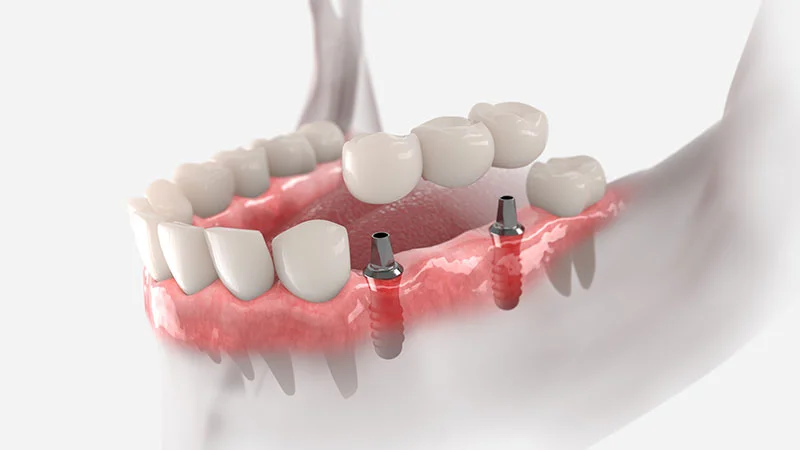
A successful implant treatment does not depend solely on placing the implant securely and correctly into the jawbone. The part that the patient sees, chews with, and uses in everyday life is the prosthetic restoration placed on top of the implant. For this reason, proper prosthetic planning is just as important as accurate surgical implant positioning for the long-term success of treatment.
An implant-supported prosthesis is a fixed or removable dental restoration used to replace missing teeth with support from dental implants placed in the jawbone. A single missing tooth may be restored with an implant-supported crown, several missing teeth with an implant-supported bridge, and complete tooth loss with either a fixed full-arch restoration or an implant-supported removable prosthesis.
At Dentsmile Clinic – Üsküdar, Istanbul, we approach the surgical and prosthetic stages of implant treatment as an integrated process. The ideal position of an implant should be determined by considering where the final tooth or teeth need to be positioned.
What Is an Implant-Supported Prosthesis?
Implant-supported prostheses are restorations supported by dental implants placed in the jawbone to replace missing natural teeth.
Depending on the number of missing teeth, treatment may include:
A crown supported by a single implant
A fixed bridge supported by multiple implants
An All-on-4 or All-on-6 full-arch prosthesis
An implant-supported hybrid prosthesis
An implant-supported removable prosthesis
The type of prosthesis should not be determined solely according to patient preference. Bone structure, the number and position of implants, lip support, bite relationship, oral hygiene, and patient expectations must all be evaluated together.
What Types of Implant-Supported Prostheses Are Available?
Implant-supported prostheses can generally be divided into two main categories: fixed and removable.
Fixed Implant-Supported Prostheses
Fixed restorations are attached to dental implants and are not removed by the patient during daily use.
The simplest example is a crown placed on a single implant to replace one missing tooth. Implant-supported bridges can be used when several teeth are missing, while fixed full-arch implant restorations may be used for completely edentulous patients.
One of the main advantages of fixed implant-supported restorations is that they can provide a sensation and function closer to natural teeth.
Removable Implant-Supported Prostheses
For some completely edentulous patients, a removable prosthesis that receives support and retention from dental implants may be preferred.
Special attachment systems are placed on the implants, allowing the prosthesis to connect securely to them and provide greater retention than a conventional complete denture.
This option may be considered particularly when there are not enough implants for a fixed restoration or when the patient may benefit from a removable solution.
Single Implant-Supported Crown
When a single tooth is missing, one implant is placed into the jawbone. Once healing is complete, a customized crown is prepared and attached to the implant.
One of the most important advantages is that the healthy neighboring teeth generally do not need to be reduced.
Particularly when preparing an implant-supported crown in the anterior region, several factors should be evaluated together:
Tooth color
Tooth shape
Tooth size
Gum level
Contact points with neighboring teeth
Smile line
With a well-designed anterior implant restoration, our goal is to make the implant-supported tooth as indistinguishable as possible from the surrounding natural teeth.
What Is an Implant-Supported Bridge?
When several adjacent teeth are missing, it is not always necessary to place an individual implant for every missing tooth.
In suitable cases, a fixed bridge replacing several teeth can be supported by a selected number of implants.
For example, when three teeth are missing, a three-unit bridge may sometimes be supported by two implants if the anatomical and biomechanical conditions are appropriate.
However, attempting to minimize the number of implants at all costs is not the correct approach. The appropriate number of implants should be determined according to the forces the prosthesis will carry and the amount and quality of available bone.
Fixed Full-Arch Implant-Supported Prosthesis
Patients who have lost all their teeth may receive a fixed full-arch prosthesis supported by a selected number of implants.
Treatment options in this category include:
All-on-4
All-on-6
Fixed bridges supported by multiple implants
The number of implants is determined according to the patient's bone structure, anatomy, and planned prosthesis.
In full-arch rehabilitation, simply replacing the missing teeth is not always sufficient. The loss of gum and bone volume that may have occurred over the years must also be considered.
For some patients, only the missing teeth need to be recreated. In others, both the teeth and the lost pink gum tissues may need to be reproduced as part of the prosthetic restoration.
What Is an Implant-Supported Hybrid Prosthesis?
Hybrid prostheses are fixed implant-supported restorations used particularly in completely edentulous patients.
They can be designed to replace both missing teeth and, when necessary, lost gum tissue volume.
A hybrid prosthesis is not removed by the patient during daily use. However, it may be designed so that the dentist can remove it when professional maintenance, repair, or other procedures are required.
For this reason, ensuring that the prosthesis can be effectively cleaned is extremely important.
Can Zirconia Be Used for Implant-Supported Prostheses?
Yes. Zirconia is one of the materials commonly used for implant-supported restorations.
It can be particularly useful in areas with high aesthetic demands because of its ability to provide a natural tooth-like appearance.
However, zirconia is not necessarily the appropriate material for every patient.
When selecting the prosthetic material, we consider:
Number of implants
Length of the prosthesis
Chewing forces
Teeth or restorations in the opposing jaw
Teeth clenching or grinding
Aesthetic expectations
Prosthetic design
Material selection is one component of treatment planning and does not determine treatment quality on its own.
Screw-Retained or Cement-Retained Implant Prosthesis?
Fixed implant-supported restorations may be screw-retained or cement-retained, depending on their connection to the implants.
Screw-Retained Prostheses
The prosthesis is secured to the implant or abutment with a screw.
One of the main advantages is that it can generally be removed more easily by the dentist when necessary, which can be beneficial for maintenance and repair.
Cement-Retained Prostheses
In this system, the prosthesis is bonded to an implant abutment using dental cement.
It may be preferred in certain cases because of aesthetic considerations or implant angulation. However, it is extremely important to ensure that excess cement is not left around the implant.
The most appropriate system is selected according to implant position and prosthetic design.
How Is an Implant-Supported Prosthesis Made?
Evaluation of the Implants
The implants are examined to confirm successful integration with the bone and healthy surrounding gum tissues.
If the implants are ready for the prosthetic stage, impressions can then be taken.
Digital Impressions
In suitable cases, digital intraoral scanning can now be used instead of conventional impression materials.
Special scan bodies are used to digitally record the precise positions of the implants.
Prosthetic Design with CAD/CAM
The collected data can then be processed digitally to design the implant-supported restoration.
With CAD/CAM technology, important aspects of the prosthesis can be planned with high precision, including:
Fit with the implants
Contact with neighboring teeth
Bite relationship
Anatomical form
Aesthetic and Functional Evaluation
Before the permanent prosthesis is completed, particularly in extensive restorations, we evaluate:
Tooth length
Tooth shape
Color
Smile line
Lip support
Speech
Bite relationship
Placement of the Prosthesis
After the final checks have been completed, the prosthesis is either screwed onto the implants or secured using the appropriate connection method.
The bite is checked again, and the patient is shown how to clean and maintain the restoration.
Why Is Passive Fit Important in Implant-Supported Prostheses?
Particularly in restorations connecting multiple implants, it is important for the prosthetic framework to fit the implants as precisely and passively as possible.
A poorly fitting prosthesis can generate unwanted forces on the implants and prosthetic screws.
Over time, this may contribute to problems such as:
Screw loosening
Screw fracture
Prosthetic fractures
Mechanical stress around the implants
For this reason, the precision offered by digital impressions and CAD/CAM technologies can provide an important advantage in implant-supported prosthodontics.
Advantages of Implant-Supported Prostheses
Properly planned implant-supported prostheses can provide:
Fixed replacement of missing teeth
Restoration of chewing function
Improved aesthetics
Preservation of healthy neighboring teeth
Reduced retention problems associated with removable dentures
Improved speech and everyday comfort
However, long-term success depends not only on the materials used but also on proper planning and regular maintenance.
Do Implant-Supported Prostheses Look Natural?
With appropriate planning and material selection, highly natural-looking results can be achieved.
Particularly in the anterior region, simply matching the tooth color is not enough.
The natural appearance is also influenced by:
Light transmission
Surface texture
Tooth shape
Relationship with the gum tissue
Proportion relative to neighboring teeth
In full-mouth restorations, the teeth should also harmonize with the patient's facial features, lips, age, and individual smile characteristics.
How Long Do Implant-Supported Prostheses Last?
It is important to distinguish between the implant itself and the prosthesis attached to it.
An implant within the jawbone may remain healthy for many years, while the prosthetic restoration, which is continuously exposed to chewing forces, may eventually require maintenance, repair, or replacement.
The lifespan of the prosthesis is influenced by:
Material used
Prosthetic design
Bite relationship
Teeth clenching and grinding
Oral hygiene
Dietary habits
Regular dental examinations
Implant-supported prostheses should therefore not be considered restorations that will never require maintenance throughout a patient's lifetime.
How Should an Implant-Supported Prosthesis Be Cleaned?
Oral hygiene is one of the areas we emphasize most strongly in implant treatment.
Dental implants cannot develop cavities, but the gum and bone tissues surrounding them can develop disease.
Particularly beneath fixed implant-supported bridges and full-arch restorations, plaque and food debris should not be allowed to accumulate.
Depending on the type of prosthesis, patients may use:
A manual toothbrush
An electric toothbrush
Interdental brushes
Special dental floss for implant restorations
An oral irrigator
The appropriate cleaning method depends on the design of the prosthesis.
A well-designed implant prosthesis should not only be aesthetic and durable; it should also be cleanable by the patient.
Risk of Peri-Implantitis with Implant-Supported Prostheses
Dental implants themselves cannot develop tooth decay. However, bacterial plaque can cause disease in the tissues surrounding the implants.
Inflammation initially limited to the soft tissues is known as peri-implant mucositis.
If inflammation progresses and affects the bone surrounding the implant, peri-implantitis may develop.
For this reason, the idea that there is no need to visit the dentist once implant treatment has been completed is incorrect.
Regular professional examinations are an important part of maintaining implants over the long term.
What Happens If an Implant-Supported Prosthesis Breaks?
Depending on the type of prosthesis and the extent of the damage, the restoration may be repaired or replaced.
The ability of screw-retained restorations to be removed by the dentist when necessary may make certain maintenance and repair procedures easier.
If a fracture, crack, or movement is noticed in the prosthesis, the patient should consult a dentist rather than continuing to use it. A minor mechanical problem may be easier to resolve when treated early.
Implant-Supported Prosthesis Prices
The cost of an implant-supported prosthesis varies according to the type and extent of the restoration.
The main factors affecting cost include:
Whether the restoration is a single crown, bridge, or full-arch prosthesis
Number of implants
Whether the prosthesis is fixed or removable
Material used
Zirconia or other framework options
Whether the prosthesis is screw-retained or uses another attachment system
Digital design and manufacturing process
Overall complexity of the case
For this reason, it is not appropriate to evaluate the cost of an implant-supported prosthesis solely on a "price per tooth" basis.
Implant-Supported Prostheses at Dentsmile Clinic
At Dentsmile Clinic – Üsküdar, Istanbul, we consider implant-supported prosthetic treatment to be a continuation of the surgical implant planning process.
When clinically indicated, we use:
3D Dental Tomography (CBCT)
Digital intraoral scanning
CAD/CAM technology
CEREC systems
Digital smile design
to help ensure that implants and their final restorations are planned in harmony with one another.
One important observation from our many years of experience with implant treatment is that patients often focus primarily on the implant brand. However, the design of the prosthesis, bite relationship, cleanability, and precise fit with the implants are just as important as the implant itself for the overall success of treatment.
In successful implant dentistry, surgery and prosthetic treatment cannot be considered independently.
Frequently Asked Questions
What is an implant-supported prosthesis?
An implant-supported prosthesis is a crown, bridge, or full-arch restoration that receives support from dental implants placed in the jawbone.
Are implant-supported prostheses fixed?
Both fixed and removable options are available. Single crowns, implant-supported bridges, and many full-arch restorations may be fixed, while certain implant-supported prostheses are designed to be removed by the patient.
Can an implant-supported prosthesis be removed?
Fixed screw-retained restorations are not removed by the patient but can be removed by the dentist when necessary. Removable implant-supported prostheses can be taken out by the patient for daily cleaning.
Can zirconia be used for implant-supported prostheses?
Yes. Zirconia can be used for implant-supported restorations. However, material selection should be based on the prosthetic design, bite relationship, and individual clinical requirements.
When is an implant-supported prosthesis placed?
In most cases, the permanent prosthesis is prepared after sufficient integration between the implants and jawbone has occurred. In suitable cases, a temporary prosthesis may also be placed on the day of implant surgery.
Can food get underneath an implant-supported prosthesis?
Particularly with fixed full-arch restorations, there is usually a specific cleaning space beneath the prosthesis. These areas need to be cleaned regularly using appropriate brushes, dental floss, or an oral irrigator.
Can an implant-supported prosthesis be replaced?
Yes. If the implants within the jawbone remain healthy, an existing prosthesis can be replaced and a new restoration can be prepared on the same implants.
The Final Outcome of Implant Treatment Is Revealed When the Prosthesis Is Completed
Successful placement of an implant into the jawbone is a crucial stage of treatment. However, from the patient's perspective, the true outcome becomes apparent when the final tooth or prosthesis is placed and begins to function.
A well-designed implant-supported prosthesis should not only look natural. It should allow comfortable chewing, provide an appropriate bite, support natural speech, avoid unnecessary forces on the implants, and be easy for the patient to clean every day.
At Dentsmile Clinic – Üsküdar, Istanbul, our goal in implant-supported prosthetic treatment is to consider the implant and prosthesis as interconnected components of a single treatment and provide our patients with natural-looking, functional, cleanable restorations designed for long-term use.