
Implant Treatments
Zygomatic Implants
What Are Zygomatic Implants? Implant Treatment for Severe Upper Jaw Bone Loss
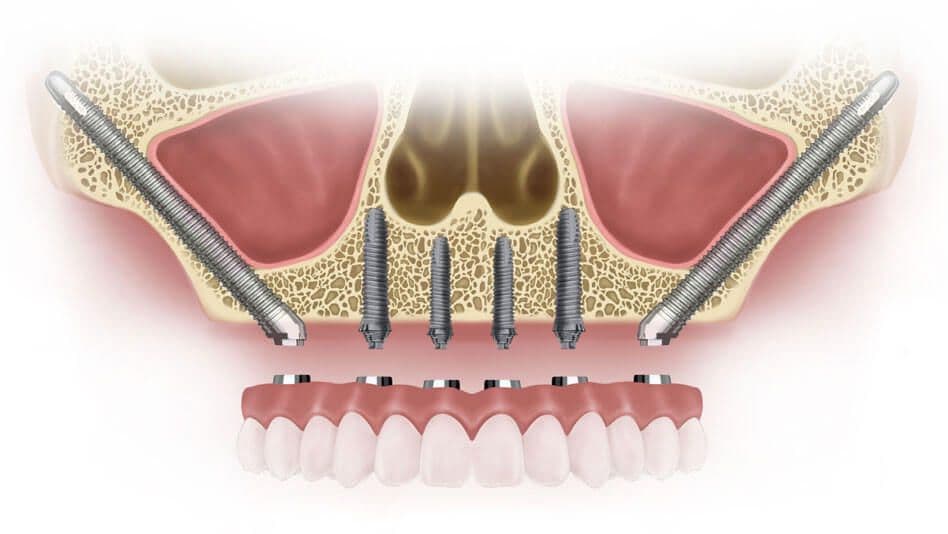
Patients who have been without teeth for many years may experience significant bone loss over time, particularly in the upper jaw. In some patients, this bone loss becomes so advanced that there is no longer sufficient bone volume to place conventional dental implants. In the past, such cases often required extensive bone grafting procedures followed by long healing periods. Today, in appropriately selected patients, zygomatic implants provide an important treatment alternative for severe upper jaw bone loss.
Zygomatic implants are specially designed implants that are considerably longer than conventional dental implants. Instead of relying primarily on the reduced upper jawbone for support, they are anchored in the zygomatic bone (cheekbone), one of the strong bony structures of the face.
At Dentsmile Clinic, when evaluating zygomatic implant treatment in Üsküdar and Istanbul, we do not consider only the amount of remaining jawbone. Using 3D imaging, we carefully assess the upper jaw, maxillary sinuses, zygomatic bone, and surrounding anatomical structures. Because this is an advanced surgical procedure, appropriate patient selection and detailed treatment planning are among the most important factors for success.
What Is a Zygomatic Implant?
A zygomatic implant is a specialized, long dental implant used in cases of severe upper jaw bone loss where the remaining maxillary bone is insufficient to support conventional implants.
While traditional implants are primarily anchored within the jawbone, one of the main anchorage points for zygomatic implants is the zygomatic bone.
The length and placement technique of these implants differ significantly from those of conventional dental implants. Treatment is primarily considered for patients with severe maxillary atrophy.
The objective is to provide the possibility of an implant-supported fixed prosthesis and, in selected cases, offer an alternative to extensive bone grafting procedures.
Who Is a Candidate for Zygomatic Implants?
Zygomatic implants are not routinely used for every implant patient. They are considered in selected cases where conventional implant placement is not possible because of insufficient bone or where advanced bone reconstruction would otherwise be required.
They may particularly be considered for patients who:
Have severe bone loss in the upper jaw
Have been completely without upper teeth for many years
Do not have sufficient upper jawbone for conventional implants
Have previously undergone unsuccessful bone grafting procedures
Wish to avoid extensive bone grafting and are anatomically suitable for an alternative approach
Have lost previous upper jaw implants because of severe bone loss
However, the decision to use zygomatic implants is not based solely on bone volume. The patient's general health, sinus anatomy, oral hygiene, existing infections, and the planned prosthetic restoration must also be evaluated.
Why Does Upper Jawbone Volume Decrease Over Time?
After teeth are extracted, the jawbone no longer receives the same functional stimulation from natural tooth roots. As a result, gradual bone resorption can occur.
In the posterior upper jaw, anatomical changes in the maxillary sinuses can further reduce the amount of available bone. As the sinus cavity expands downward, the bone height available for implant placement may become increasingly limited.
Following long-term tooth loss, some patients may develop severe bone loss in both vertical and horizontal dimensions.
When there is insufficient bone for conventional implants, advanced treatment options such as bone grafting, sinus lift procedures, or, in suitable patients, zygomatic implants may be considered.
What Is the Difference Between Zygomatic Implants and Conventional Implants?
The primary differences are the implant length and the bone used for anchorage.
Conventional dental implants are generally placed within the jawbone where the roots of natural teeth were previously located.
Zygomatic implants are considerably longer and, in cases of severe upper jaw bone loss, are planned to obtain support from the zygomatic bone.
For this reason, zygomatic implant surgery is more complex than conventional implant surgery and requires advanced surgical planning and experience.
How Is Zygomatic Implant Treatment Planned?
Comprehensive Clinical Examination
The first stage involves evaluating the patient's:
Oral tissues
Existing teeth or prostheses
Gum health
Bite relationship
Facial and lip support
The patient's general medical condition and medications are also important components of treatment planning.
Evaluation with 3D Dental Tomography
3D Dental Tomography (CBCT) is one of the fundamental planning tools for zygomatic implant treatment.
Three-dimensional images allow detailed assessment of:
Upper jawbone
Zygomatic bone
Maxillary sinuses
Nasal cavity
Available bone volume
Potential trajectories of implant placement
The length, angle, and position of the implants can then be planned in relation to the surrounding anatomical structures.
How Is Zygomatic Implant Treatment Performed?
Zygomatic implant placement is a more advanced surgical procedure than conventional implant surgery.
The appropriate anesthesia method is selected according to the complexity of the procedure and the patient's individual condition. Following the treatment plan, the implants are positioned so that they extend from the upper jaw toward and engage the zygomatic bone.
Depending on the case, zygomatic implants may be used together with conventional dental implants.
For example, if sufficient bone is available in the anterior upper jaw, conventional implants may be placed in this region while zygomatic implants are used posteriorly to provide the support required for a fixed prosthesis.
The same implant configuration should not be used for every patient. The number and distribution of implants must be determined according to the patient's individual anatomy.
What Is Quad Zygoma?
In certain patients with severe atrophy affecting almost the entire upper jaw, there may not be sufficient bone available even for conventional implants in the anterior region.
In selected cases, an approach using a total of four zygomatic implants, with two implants placed on each side, may be considered. This technique is generally referred to as Quad Zygoma.
Quad Zygoma is an advanced surgical approach and should only be considered in patients with suitable anatomical conditions.
Can Fixed Teeth Be Placed on the Same Day as Zygomatic Implants?
In suitable cases, the high primary stability that can be achieved with zygomatic implants may allow early or immediate loading protocols to be considered.
A temporary fixed prosthesis may therefore be prepared following implant placement.
However, receiving zygomatic implants does not automatically mean that fixed teeth can be placed on the same day.
The decision depends on:
Primary stability of the implants
Distribution of the implants
Patient's bite
Bone structure
Design of the planned prosthesis
The fixed teeth used during the initial period are generally temporary restorations. Once healing has been completed, the permanent prosthesis is prepared.
What Are the Advantages of Zygomatic Implants?
May Provide a Fixed Prosthetic Option in Severe Bone Loss
Zygomatic implants may allow an implant-supported fixed prosthesis to be provided in patients with severe upper jaw bone loss where conventional implants cannot be placed.
May Provide an Alternative to Extensive Bone Grafting
In suitable patients, zygomatic implants may reduce or eliminate the need for extensive bone grafting procedures.
However, this does not apply to every case. The decision between bone grafting and zygomatic implant treatment must be individualized.
May Shorten the Overall Treatment Period
Extensive bone grafting may require a prolonged healing period before implants can be placed. In suitable zygomatic implant cases, avoiding this stage may shorten the overall treatment time.
May Allow the Use of Fixed Teeth
For some patients who have used removable dentures for many years because of severe bone loss, the possibility of receiving a fixed implant-supported prosthesis can significantly improve comfort and quality of life.
Are There Risks Associated with Zygomatic Implants?
Zygomatic implant treatment is an advanced surgical procedure and, like any surgical treatment, involves certain risks.
Possible complications may include:
Sinus-related complications
Infection
Soft tissue problems
Inflammation around the implants
Implant failure
Mechanical complications involving the prosthesis
For this reason, detailed 3D assessment before treatment and regular postoperative follow-up are important.
It would be incorrect to consider a zygomatic implant simply as a "longer version" of a conventional implant. It is an advanced surgical treatment performed in a considerably more complex anatomical region.
Zygomatic Implants or Bone Grafting?
There is no single answer that applies to every patient.
For some patients, bone grafting to create sufficient bone for conventional implants may be the more appropriate treatment.
For another patient with severe bone loss, zygomatic implants may provide a more suitable alternative.
The decision should consider:
Severity of bone loss
Condition of the maxillary sinuses
Patient's general health
Previous surgical procedures
Expected treatment duration
Planned fixed prosthesis
Healing After Zygomatic Implant Surgery
Because zygomatic implant surgery is more extensive than conventional implant placement, a specific healing period should be expected after the procedure.
During the first few days, patients may experience:
Swelling
Tenderness
Bruising
Mild to moderate discomfort
It is important to take prescribed medications as instructed, follow dietary recommendations, and attend scheduled follow-up appointments.
If immediate loading has been performed, hard foods should be avoided while the temporary prosthesis is being used.
Oral Care After Zygomatic Implant Treatment
Good oral hygiene is essential for the long-term success of zygomatic implants.
Plaque accumulation should be prevented beneath the fixed prosthesis and around the areas where the implants emerge into the oral cavity.
Depending on the prosthetic design, oral hygiene may involve:
Toothbrushes
Interdental brushes
Dental floss designed for implant-supported restorations
Oral irrigators
Particularly with fixed full-arch restorations, aesthetics alone are not enough. The prosthesis must also be designed so that the patient can clean it effectively.
How Long Do Zygomatic Implants Last?
It is not appropriate to give a specific lifespan that applies to every zygomatic implant patient.
Long-term success depends on:
Appropriate patient selection
Surgical planning
Implant positioning
Prosthetic design
Distribution of chewing forces
Oral hygiene
Smoking
Regular professional examinations
With the correct indication and appropriate long-term follow-up, zygomatic implants can provide many years of function.
Zygomatic Implant Prices
The cost of zygomatic implant treatment differs from conventional implant treatment because it requires more extensive surgical planning and specialized implant systems.
Treatment costs may be influenced by:
Number of zygomatic implants required
Whether they will be combined with conventional implants
Unilateral or bilateral treatment
Need for a Quad Zygoma approach
Type of anesthesia
Temporary prosthesis
Material used for the permanent prosthesis
Additional surgical procedures
For this reason, it is not appropriate to establish a standardized zygomatic implant treatment plan without first performing a clinical examination and evaluating 3D CBCT images.
Zygomatic Implant Planning at Dentsmile Clinic
At Dentsmile Clinic – Üsküdar, Istanbul, patients with severe bone loss undergo detailed clinical and radiographic evaluation before treatment options are determined.
When clinically indicated, our planning process may combine:
3D Dental Tomography (CBCT)
Digital intraoral scanning
Digital implant planning
CAD/CAM technology
Digital prosthetic and smile planning
One point we particularly emphasize in zygomatic implant treatment is that this technique should not automatically be selected for every patient with severe bone loss. In some cases, bone grafting and conventional implants may be more appropriate; in others, All-on-4 or All-on-6 may provide the preferred solution; while in selected advanced cases, zygomatic implants may be indicated.
Successful treatment begins not with choosing the most advanced procedure, but with choosing the right treatment for the right patient.
Frequently Asked Questions
What is a zygomatic implant?
A zygomatic implant is a specialized, long dental implant that obtains support from the zygomatic, or cheekbone, in patients with severe upper jaw bone loss.
Can zygomatic implants be placed in the lower jaw?
No. Zygomatic implants are designed for the treatment of severe bone loss in the upper jaw.
Is bone grafting required for zygomatic implants?
One of the important advantages of zygomatic implants is that they may reduce the need for extensive bone grafting in suitable patients. However, every patient's anatomy is different, and the need for additional surgical procedures can only be determined after a comprehensive examination.
Can fixed teeth be provided after zygomatic implant treatment?
Yes. One of the main objectives of treatment is to provide an implant-supported fixed full-arch prosthesis. In selected cases where adequate implant stability is achieved, a temporary fixed prosthesis may be placed during the early treatment period.
How many zygomatic implants are required?
The same number of implants is not used for every patient. Zygomatic implants may be combined with conventional implants, while in advanced cases a Quad Zygoma approach using four zygomatic implants may be considered.
Is zygomatic implant surgery a difficult procedure?
Compared with conventional implant placement, it is anatomically and surgically more complex. It therefore requires advanced planning, appropriate surgical conditions, and careful follow-up.
Severe Bone Loss Does Not Necessarily Mean Implant Treatment Is No Longer Possible
For a patient with severe upper jaw bone loss, concluding that "implants cannot be placed" based solely on a panoramic X-ray may not provide a sufficiently comprehensive assessment. Today, advanced 3D imaging and implant surgery allow alternative treatment options to be considered for some patients in whom conventional implants cannot be placed.
Zygomatic implant treatment is one of these options.
At Dentsmile Clinic – Üsküdar, Istanbul, our priority in cases of severe upper jaw bone loss is to evaluate each patient's anatomy in detail and develop the most appropriate long-term treatment plan from the available options, ranging from conventional implants and bone augmentation procedures to full-arch rehabilitation and zygomatic implants.