
Blog
Dental Bridge
What Is a Dental Bridge? Dental Bridge Treatment in Üsküdar
Published:
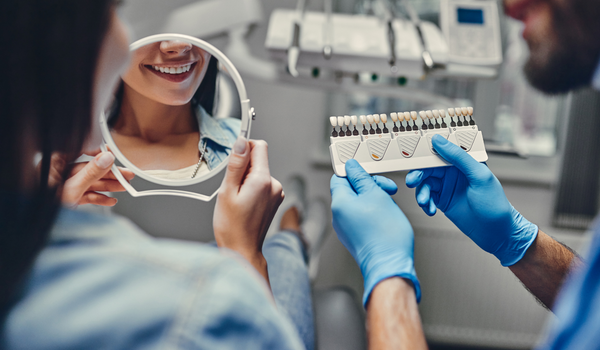
A dental bridge is a type of fixed prosthetic treatment used to replace one or more missing teeth. If there are suitable supporting teeth on both sides of the gap, these teeth can be used to support a fixed restoration that replaces the missing tooth or teeth.
Tooth loss is not only an aesthetic concern. Over time, teeth adjacent to the missing tooth may move toward the gap, the opposing tooth may extend into the space, and the balance of chewing forces may change. However, the extent and rate of these changes vary from patient to patient.
At Dentsmile Oral and Dental Health Clinic, when planning dental bridge treatment in Üsküdar, we evaluate the number and location of missing teeth, the condition of potential supporting teeth, bite relationships, and the patient’s overall oral health.
How Is a Dental Bridge Made?
In a traditional dental bridge, suitable teeth adjacent to the missing tooth are prepared to serve as supports for the bridge. Crowns are placed over these supporting teeth, while the missing tooth is replaced by an artificial tooth known as a pontic.
Because these components are connected to one another, the bridge cannot be removed and reinserted by the patient and remains fixed in the mouth.
The condition of the supporting teeth is particularly important before treatment. Large cavities, existing fillings, previous root canal treatments, gum health, and the level of bone supporting the teeth are evaluated.
If the supporting teeth require treatment, these problems should, whenever possible, be addressed before the bridge is placed.
Types of Dental Bridges
The type of bridge used is determined according to the location of the missing tooth and the condition of the surrounding teeth.
A traditional dental bridge is one of the most commonly used options. It is supported by suitable teeth on both sides of the missing tooth or teeth.
A cantilever bridge is supported from only one side of the missing tooth. Because this design is not suitable for the chewing forces in every area of the mouth, its indications are limited and careful case selection is required.
A Maryland bridge (resin-bonded bridge) may allow more conservative preparation of neighboring teeth compared with a traditional bridge. It generally uses wings on the back of the restoration that are bonded to suitable surfaces of the adjacent teeth. It may be considered particularly for certain missing teeth in the front region.
The appropriate type of bridge should not be determined solely by the number of missing teeth. Chewing forces in the area and the condition of the supporting tissues must also be considered.
Dental Bridge or Implant?
For patients with one or several missing teeth, one of the most common treatment decisions involves choosing between a dental bridge and dental implant treatment.
With a traditional bridge, the neighboring teeth must be used as supports and prepared to a certain extent. With implant treatment, when bone volume and general health conditions are suitable, an implant can be placed in the missing tooth area, allowing the restoration to be completed independently of the neighboring teeth.
However, an implant is not automatically the most appropriate option for every patient. Bone volume, systemic health, the anatomy of the missing tooth area, existing restorations on neighboring teeth, and the patient’s treatment expectations should all be considered.
For example, if the teeth on both sides of the missing tooth already have large restorations, a dental bridge may be an appropriate option. On the other hand, if completely healthy neighboring teeth would need to be prepared solely to support a bridge, it may also be beneficial to consider an implant-supported option.
The decision should be made individually for each patient.
What Materials Are Used for Dental Bridges?
With advances in dental technology, several different materials can be used for dental bridge restorations.
Depending on the individual case, options may include:
Zirconia
Zirconia-based ceramic restorations
Porcelain-fused-to-metal restorations
All-ceramic systems
Metal alloys in selected cases
Material selection should not be based solely on aesthetic appearance. The location and length of the bridge, chewing forces, opposing teeth, and the characteristics of the supporting teeth are also important.
In the front region, achieving a natural appearance may be a greater priority, while in the posterior region, durability and appropriate management of chewing forces may become more important.
How Does Dental Bridge Treatment Proceed?
Treatment begins with a detailed examination of the teeth and oral tissues. When necessary, radiographic examinations are performed to evaluate the supporting teeth and surrounding bone.
The teeth that will support the bridge are prepared appropriately, and either a conventional impression or a digital intraoral scan is taken.
While the permanent bridge is being fabricated, a temporary restoration may be used to meet the patient’s aesthetic and functional needs.
During the try-in stage, the bridge is evaluated for its fit on the supporting teeth, bite relationship, interaction with the gums, shade, and overall appearance.
Once the necessary adjustments have been completed, the bridge is fixed in place using appropriate dental materials.
The total treatment time may vary depending on the type of bridge, whether additional treatment is required for the supporting teeth, and the fabrication method used.
How Should a Dental Bridge Be Cleaned?
Good oral hygiene is extremely important for the long-term success of dental bridge treatment.
Because there is no natural tooth root beneath the artificial tooth portion of the bridge, cleaning this area with conventional dental floss may not always be possible. For this reason, super floss, floss threaders, or suitable interdental brushes may be recommended for cleaning underneath the bridge.
It is particularly important to clean thoroughly around the margins of the teeth supporting the bridge. Plaque accumulation in these areas may lead to tooth decay or gum problems over time.
Having a dental bridge does not mean that the supporting teeth can no longer develop cavities. Regular oral hygiene and dental check-ups are therefore important for the longevity of the bridge.
How Long Can a Dental Bridge Last?
It is not appropriate to define the lifespan of a dental bridge with a single fixed number.
The design of the bridge, the condition of the supporting teeth, oral hygiene, teeth clenching or grinding habits, chewing forces, and regular dental check-ups all directly affect how long the restoration can be used.
Even if the bridge itself remains intact, decay, periodontal disease, or a root-related problem affecting one of the supporting teeth may require the restoration to be replaced.
For this reason, long-term success depends not only on the quality of the material used but also on appropriate case selection and maintaining the health of the supporting teeth.
Dental Bridge Treatment in Üsküdar
At Dentsmile Oral and Dental Health Clinic, when planning dental bridge treatment in Üsküdar, we first evaluate whether the area of the missing tooth is suitable for bridge treatment.
After assessing the health of the neighboring teeth, their bone support, bite relationships, and the number of missing teeth, traditional bridges, resin-bonded bridges, or other appropriate fixed prosthetic options may be considered. For patients who are suitable candidates for dental implants, implant-supported treatment is also considered as part of the treatment planning process.
Our primary approach is not simply to close the gap created by a missing tooth, but to plan a long-lasting restoration by considering chewing function, the health of the supporting teeth, and a result that is as close to a natural appearance as possible.